When building business workflows, choosing the right automation tool is critical. Zapier and Make are the two leading platforms, but they target different styles of builders and feature vastly different pricing structures. For a solopreneur, choosing the wrong platform can result in bloated monthly bills or workflows that are difficult to debug.
ROI Comparison by Operation Count
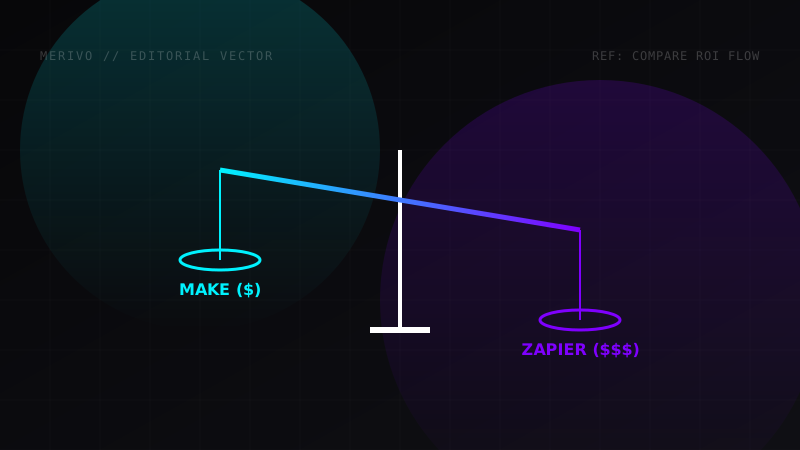
The fundamental difference lies in how they count usage. Zapier charges per Task (successful action execution), whereas Make charges per Operation (any step executed, whether successful or filtered). Despite Make counting operations, its tiers scale significantly cheaper.
| Monthly Tasks/Ops | Zapier Cost | Make Cost | Cost Savings |
|---|---|---|---|
| 1,000 tasks/ops | $29.99/mo | Free / $9/mo | ~70% |
| 10,000 tasks/ops | $149/mo | ~ $18.82/mo | ~87% |
| 50,000 tasks/ops | $399/mo | ~ $54.12/mo | ~86% |
| 100,000 tasks/ops | $599/mo | ~ $101.65/mo | ~83% |
Visual Workspaces vs. Simple Flows
- Zapier (Trigger-Action): Designed for simplicity. If a new row is added in Airtable, send a Slack message. It is easy to configure but becomes messy when building multi-branch conditional flows.
- Make (Visual Map): Designed as a visual mindmap. You can drag, drop, clone, and route data across dozens of nodes, apply filters on specific paths, and handle error routes natively.
Technical Capabilities and Limitations
Data Mapping and Variables
Make treats data processing like a programming environment. You have access to detailed array operations, collection mapping, regular expressions, and native math functions. Zapier can handle basic text transformations, but complex mappings often require you to write custom Python or JavaScript actions.
Webhook Latency and Performance
Both platforms support webhooks. Make's custom webhooks are instant and run on the free tier. Zapier locks multi-step webhooks behind paid tiers, making it harder to prototype APIs without paying upfront.
Router & Conditional Logic
Make's routers allow you to split a single execution stream into infinite parallel paths. Each path can filter data independently. In Zapier, this requires nesting multiple "Paths" (available only on the high-tier Professional plan).
Recommendation Guide
If you are a beginner looking for a 5-minute setup and your workflows are strictly linear, Zapier is the easiest option. For complex programmatic automations with hundreds of thousands of operations, Make offers the best pricing and architectural capabilities for scaling solopreneurs.